
Adhesive Vinyl Pockets & Job Jackets
Pick your size
Showing all 2 results
-

Custom Vinyl Pockets
MOQ 250 · Made to order As low as $0.55(C)at 3,000+ units Add to cart -
Pocket Protector
MOQ 500 · Made to order As low as $1.03(C)at 10,000+ units Add to cart
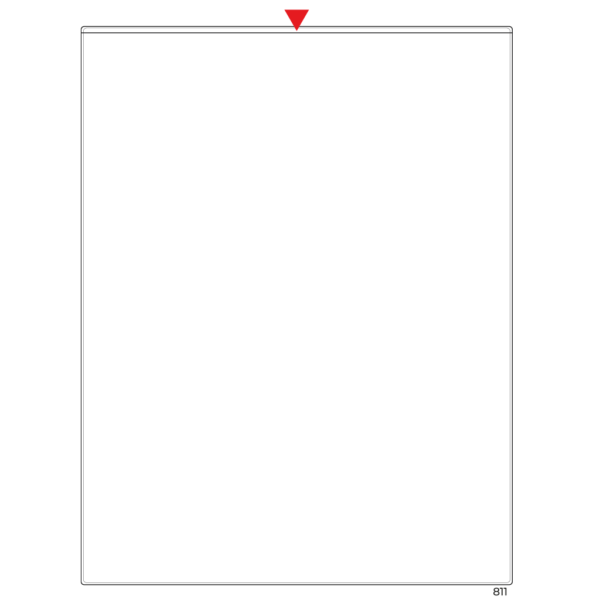
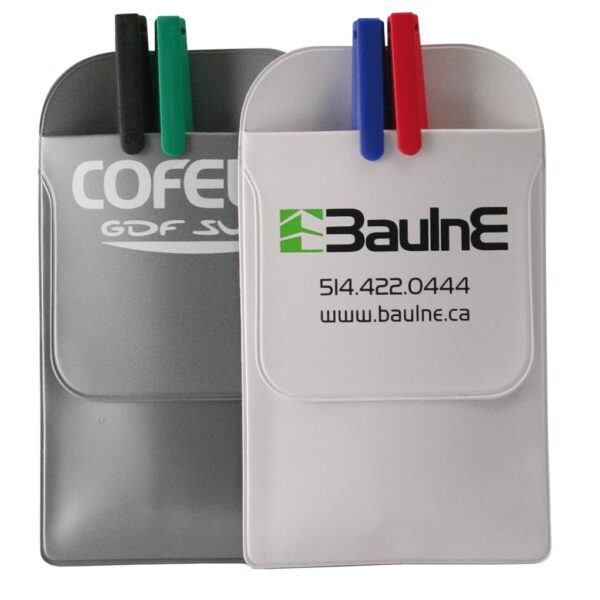
The least glamorous product we make, and one of the most reordered: a clear pocket that holds a document where the work actually happens.
A vinyl pocket solves a problem nobody writes a purchase order for until it bites them. A work order that has to travel with the part. A drawing that has to stay on the machine and stay readable. An inspection card that has to be visible on a rack without being taped to it. A parts list that lives on a bin. Paper on its own does not survive any of those environments — but paper in a welded vinyl pocket does, and the pocket costs a fraction of laminating a document that is going to change next month anyway.
The reusable-window argument. This is the reason most customers switch to pockets and stay. A laminated sheet is finished the moment the revision changes; a pocket is a window you reload. When the drawing is superseded, the routing changes, the inspection is re-signed or the price list is reissued, you print the new sheet and swap it. The pocket stays on the machine. For anything on a revision cycle — engineering drawings, shop travellers, safety data sheets, WHMIS binder inserts, price lists, capacity plates — that is the whole economic case in one sentence.
Mounting is the specification that matters most. Everything else about a pocket is easy; how it attaches is what determines whether it is still there in a year. Pressure-sensitive adhesive backing is the default and works on clean, smooth, low-energy-free surfaces such as painted steel, powder coat, sealed wood and most rigid plastics — it does not like dust, oil, raw concrete or anything below freezing at the moment of application. Magnetic backing is the right answer on any ferrous surface a shopper needs to move: racking, machine housings, panel doors, filing cabinets. Grommets and hang holes suit racking and pegboard. Wall-mount pockets with a mounting flange take screws or rivets and hold a much heavier document stack than an adhesive pocket ever will. And a plain welded pocket with no attachment at all is often what a job-jacket customer wants, because it lives in a tote.
Made to your size, not to a catalogue. We are a manufacturer, so the standard sizes below are starting points rather than a menu. If your document is an odd format, if you need a thumb notch to get a card out with gloves on, if the opening has to be on the short edge so the sheet does not fall out when the pocket is mounted horizontally, if you want a closure flap or a business-card pocket welded onto the face — those are all just weld positions on a die. Send us the document and how it gets handled, and we will build the pocket around it.
Branding. Pockets can be silk screened or foil stamped on the vinyl itself, or built with a printed header card welded in behind the window so your logo and instructions sit above the document and never come out. The header approach is the one to choose if the pocket is going anywhere a customer or an auditor will see it.
Common formats
- Letter
- Holds an 8 1/2" x 11" sheet — shop travellers, work orders, SDS pages, drawings
- Legal
- Holds 8 1/2" x 14" — permits, contracts, longer routing sheets
- Half letter
- Holds 5 1/2" x 8 1/2" — bin cards, inspection records, pick lists
- Card and badge
- Sized to the card, most often ISO/IEC 7810 ID-1 at 3 3/8" x 2 1/8"
- Custom
- Any size the document requires — we build the die around your sheet, not the other way round
Construction and mounting
- Material
- Clear flexible vinyl film, optically clear so a barcode still scans through the window; heavier film where the pocket is handled every shift
- Assembly
- High-frequency welded seams — no glue and no stitching, so there is nothing to peel apart or wick moisture
- Opening
- Long edge or short edge; short edge is the one to choose for a pocket mounted horizontally
- Adhesive
- Pressure-sensitive backing, full-area or perimeter strips. Apply to a clean, dry, above-freezing surface
- Magnetic
- Flexible magnetic backing for ferrous surfaces — repositionable, and the usual choice for racking and machine panels
- Mechanical
- Grommets, hang holes, or a screw flange for wall-mount pockets carrying a heavy stack
- Extras
- Thumb notch, closure flap, hook-and-loop or snap closure, welded-in printed header card, business-card pocket on the face
Adhesive & Vinyl Pockets — answered.
What is the difference between a vinyl pocket and laminating?
Laminating seals a document permanently; a pocket holds one you can change. If the sheet inside will ever be revised — a drawing, a travelling work order, a safety data sheet, a price list — the pocket is cheaper over its life, because you reprint a sheet of paper instead of re-laminating. Laminating wins only where the document genuinely never changes and needs to be a rigid, wipeable card in its own right.
Will the adhesive hold on my surface?
Pressure-sensitive adhesive holds well on clean, smooth, dry surfaces — painted steel, powder coat, sealed wood, most rigid plastics, glass. It struggles with dust, oil, silicone-based cleaners, raw or sealed concrete, brick, and any surface that is cold at the moment you apply it. Below about 10 degrees the adhesive will not flow into the surface and the bond never fully forms. On ferrous surfaces in a dirty environment, magnetic backing is a far better answer than a stronger adhesive; on masonry, use a wall-mount pocket with a screw flange. If you are not sure, tell us the surface and we will send you a sample pocket to test before you commit to a run.
Can you make a pocket in a size that is not on this page?
Yes, and it is most of what we do. We manufacture the pockets here, so the size is set by tooling, not by a catalogue. Send us the document — or its dimensions and how it is handled — and we will build the pocket around it, including where the opening sits, whether it needs a thumb notch, and how it mounts. There is no die charge on standard rectangular shapes.
Can you print our logo on the pocket?
Two ways, and they suit different jobs. Silk screening or foil stamping directly on the vinyl puts your mark on the pocket itself and is the cleaner look on a small pocket. A welded-in printed header card gives you far more room — logo, instructions, a form title, a colour band — sitting above the window where it stays legible and cannot be removed with the document. If the pocket will be seen by a customer or an auditor, choose the header.
Do you make pockets that hold more than one sheet?
Yes. A single-sheet display pocket and a job jacket that has to swallow a forty-page package are different products: the jacket needs a deeper gusset, a heavier film and usually a closure. Tell us roughly how thick the stack gets at its worst and we will spec the gusset and the closure to it rather than guessing.
Question not answered here? Talk to our Canadian plant — 780.466.9973, Monday to Friday, 8:00 to 4:30.